 Ryan Caldwell
Key Takeaways
- E1 and E5 are the cabinet thermistor open and shorted codes; E2 and E6 are the evaporator thermistor open and shorted codes.
- The code pages list typical repair costs from $150 for E5, from $180 for E1 and E6, and from $200 for E2.
- Evaporator sensors take longer to reach, with professional times up to three hours for E2.
- Ask whether the connector and wiring were checked before the sensor was condemned.
- Final pricing is confirmed only after the model and fault are verified on site, with a written estimate before any work.
The Bottom Line
A freezer thermistor repair is a modest bill with a fair range of outcomes. Get the exact code and the model to the technician, and ask what was checked before a part was ordered.
A freezer that has started to show an E-code with nothing visibly wrong with it is often reporting a sensor, not a failing cooling system. U-Line freezers use thermistors to tell the control what the cabinet and the evaporator are doing, and four codes on this site describe those sensors failing in one of two ways. The U-Line freezer thermistor replacement cost depends on which sensor and which failure, and the code pages put a starting figure on each.
| Code | What the site says it is | Typical repair cost | Owner-fixable | Pro time |
|---|---|---|---|---|
| E5 | Cabinet thermistor shorted | from $150 | About 15 percent | 1 to 2 hours |
| E1 | Cabinet thermistor open | from $180 | About 10 percent | 1.5 to 2.5 hours |
| E6 | Evaporator thermistor shorted | from $180 | About 20 percent | 1.5 to 2.5 hours |
| E2 | Evaporator thermistor open | from $200 | About 25 percent | 1 to 3 hours |
What Is the U-Line Freezer Thermistor Replacement Cost?
On this site's code pages, E5 starts from $150, E1 and E6 from $180, and E2 from $200. Each is a typical repair cost, labeled from, not a quote, because pricing on U-Line service calls is confirmed only after the exact model and the real fault are verified on site, with a written estimate before any repair work.
The differences are modest, and the order is not intuitive. The evaporator sensors sit deeper in the cabinet, and the pages list longer professional times for them, up to three hours for E2. If you are comparing against a repair bill, expect the sensor itself to be the smaller part and the access and labor to be the larger one.
Cabinet Thermistor vs Evaporator Thermistor
The cabinet thermistor reads the temperature of the storage space, and the evaporator thermistor reads the coil that does the cooling. Both feed the control, which uses them to decide when to run the compressor and when to defrost. When either one is wrong, the control is making decisions on false information, and the freezer can run too long, too little, or defrost at the wrong moment. Owners often notice it as frost that seems heavier than before, a compressor that never seems to rest, or contents that feel soft at the edges, and none of those is specific to a sensor, which is why a diagnosis beats a guess.
The code pages describe the E-codes as model-specific control or sensor conditions that should be matched to the exact product family before parts are recommended. That sentence is the reason to be careful with parts-first advice: representative freezer models on the site include the UHRF124, HFZ124 and OFZ124, and the same code can lead to different work on different platforms.
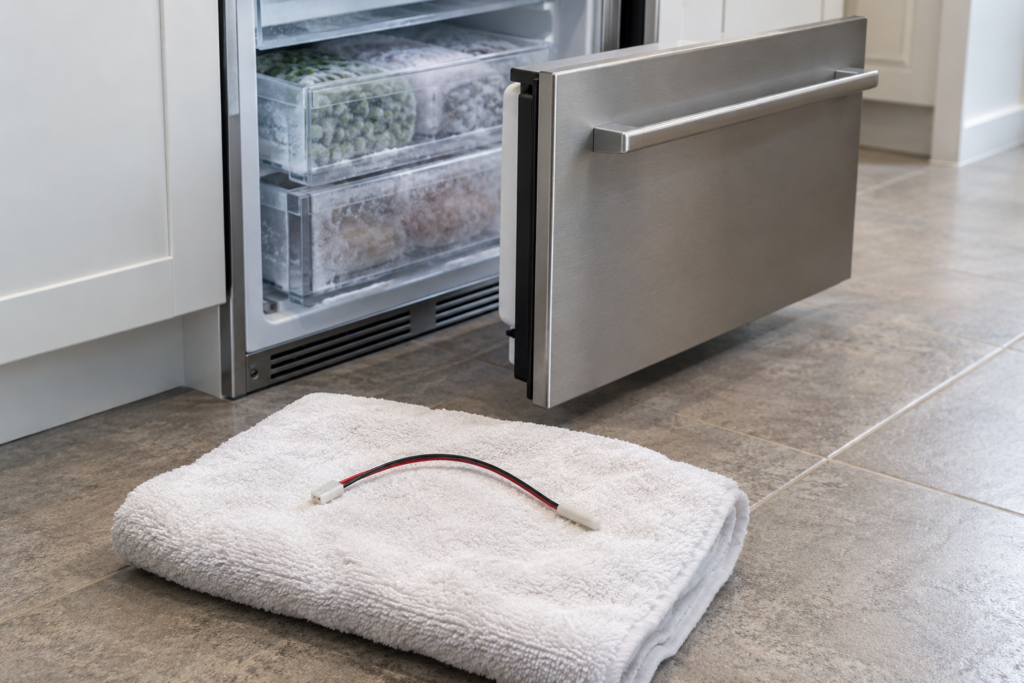
What Is the Difference Between an Open and a Shorted Thermistor?
In general terms, an open thermistor is a broken circuit, and a shorted one is a circuit that conducts when it should not. The site's code pages name these codes but do not describe their causes, so the causes below are typical ones and a technician can confirm which applies. Either way the control receives a reading it cannot trust, and it flags a code. E1 and E2 are the open cases for the cabinet and the evaporator; E5 and E6 are the shorted cases.
- E1 (cabinet open): a broken sensor circuit or a loose connection in the cabinet sensing path.
- E5 (cabinet shorted): the same sensor reading as a short, which can come from a damaged lead or sensor.
- E2 (evaporator open): a broken circuit at the evaporator sensor.
- E6 (evaporator shorted): a short at the evaporator sensor.
Because a loose connector can look exactly like a failed sensor, ask the technician whether the connection was checked before the sensor was condemned. A reseated connector is a far cheaper outcome than a new part, and the labor is the same either way.
What Drives the Final Price
Four things move a thermistor bill away from the starting figure. None of them can be known from the code alone, which is why the diagnostic comes first, and why a written estimate that names the part and the labor separately is worth asking for.
- Which sensor it is, since evaporator sensors take longer to reach than cabinet ones.
- The model, because access differs between built-in, undercounter and outdoor freezers.
- Whether the wiring or connector is the real fault, which can lower the bill.
- Whether a second fault is found, since a defrost problem and a sensor problem often travel together.
Protecting the Contents While You Wait
A sensor fault does not always stop the freezer, but it can let it drift, so treat the days before the visit as a time to protect what is inside. The code pages say to keep using the product only while it still preserves food safely, and that thawing or warming is a stop sign.
- Check the temperature with a separate thermometer, since the control's own reading is the thing in doubt.
- Keep the door closed as much as possible and avoid adding large amounts of unfrozen food.
- Move irreplaceable items to another freezer if the cabinet is warming, softening or thawing anything.
- Note the pattern, including when the code appears and whether the freezer seems to run constantly or hardly at all.
Two neighboring codes are worth knowing. The WARM-FRZ page covers a freezer that is not holding temperature, which a faulty sensor can cause, and the E0 page covers the door open alert. If your symptom is a warm freezer and no sensor code, start with the broader list in our freezer not working common causes guide.
Can You Replace a Freezer Thermistor Yourself?
The pages put the owner-fixable share at only 10 to 25 percent, and the safe checks they list stop short of opening anything. No disassembly is the rule: do not remove panels or access internal components. What you can do is confirm the code, note when it appears, check that the freezer is level, ventilated and closing properly, and keep the contents safe while you arrange service.
A restart can clear a temporary state, and the pages say so, but a code that comes back after a restart is a diagnosis, not a reset. Do not keep power-cycling it; the freezer is working with bad information each time it does.
Is a Thermistor Repair Worth Paying For?
For nearly any freezer that still holds its temperature, yes, because a sensor repair costs far less than the contents and the unit it protects. The calculation changes only on an old unit with several faults, and our guides on whether a U-Line freezer is worth repairing and U-Line freezer repair or replace cover that comparison. The related refrigerator decision is in U-Line evaporator thermistor worth fixing.
The wider cost picture for freezers is in U-Line freezer repair cost factors. The code pages for E1, E2, E5 and E6 each carry the starting figure quoted above. To get an actual quote, schedule a visit with the model and the exact code.