 Ryan Caldwell
Key Takeaways
- E2 (evaporator thermistor open) is worth fixing in nearly every case — it starts from $245, the same tier as any non-compressor repair.
- The evaporator thermistor sits outside the sealed refrigeration system, so replacing it never requires refrigerant handling.
- E2 means less efficient, less precise cooling — not a total stop — which is why it is easy to mistake for something more serious than it is.
- The code number for the evaporator thermistor is consistently E2 across refrigerators, freezers, and both wine lines this site covers.
- Replacement of the whole unit only makes sense if the thermistor failure is one of several problems happening at once.
The Bottom Line
A U-Line evaporator thermistor (E2) is one of the cheapest, easiest repairs on the whole refrigeration lineup — starting from $245, outside the sealed system, and almost never a reason to consider replacing the unit.
Code E2 shows up across nearly every U-Line refrigeration line this site covers — refrigerators, freezers, wine coolers, and wine fridges all share the same evaporator thermistor fault, even though each line has its own separate set of E-codes otherwise. That makes it one of the most common single faults an owner will encounter, and yet it has never had its own answer to the one question that actually matters: is a U-Line evaporator thermistor worth fixing? This guide is that answer, on its own, apart from the general refrigerator or wine cooler repair-or-replace conversation.
| Fault | Where it appears | Worth fixing? | Starting price |
|---|---|---|---|
| Evaporator thermistor open (E2) | Refrigerator, freezer, wine cooler, wine fridge | Yes — inexpensive, sensor-level part | from $245 |
| Cabinet thermistor open/short (E1/E5) | Refrigerator, wine cooler, wine fridge | Yes — same tier as E2 | from $245 |
| Compressor failure | Any refrigeration line | Usually — compare against unit age | from $795 |
| Door seal / 10E | Refrigerator | Yes — inexpensive | from $135 |
Is a U-Line Evaporator Thermistor Worth Fixing?
Yes, almost without exception. An evaporator thermistor is a small sensor, not a sealed-system component, and replacing one starts from $245 — the same tier as any other non-compressor repair on this site's own compressor cost breakdown. There is essentially no scenario where a working refrigeration line with a single failed thermistor is better replaced outright than repaired, because the part itself is inexpensive and the labor does not involve opening the sealed system at all.
What E2 Actually Means
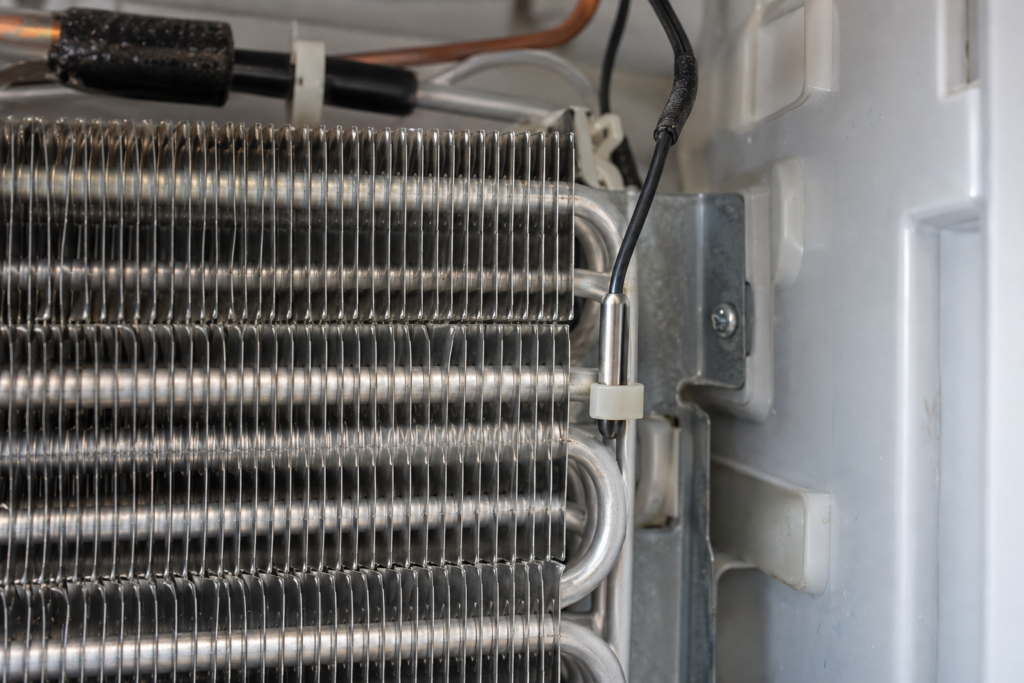
The evaporator thermistor is the sensor that reports the temperature of the evaporator coil back to the control board, which uses that reading to manage the defrost cycle and fine-tune cooling. When that sensor opens — meaning the circuit breaks rather than simply reading incorrectly — the control loses its most direct read on the coldest part of the system and often responds by running the compressor longer than necessary or mismanaging defrost timing. The unit does not stop cooling outright the way a failed compressor would; it cools less efficiently and less precisely until the sensor is replaced.
Why This Repair Costs So Much Less Than a Compressor
Because it sits entirely outside the sealed refrigeration circuit. A thermistor is a small sensor attached near the evaporator coil with a simple electrical connection back to the control board — accessing and replacing it does not require recovering refrigerant or opening any part of the system that holds pressure. That is the same distinction that separates every cheap repair on this site's fault lists from every expensive one, and it applies identically whether the sensor is on a refrigerator, a freezer, or either wine line.
- Thermistor and sensor work is connector-level and does not touch the sealed system.
- Compressor work requires refrigerant recovery, a new part, and a full recharge.
- E2 sits firmly in the first group, on every line this site documents.
- Accessing the sensor typically requires only removing an interior panel, not disassembling the cabinet.
Does It Matter Which Appliance the Thermistor Is On?
Not for the repair-worth question — the part, the labor, and the price tier are the same whether E2 shows up on a refrigerator, a freezer, or a wine cooler. What does change between lines is the code number attached to the cabinet thermistor rather than the evaporator one: refrigerators and wine lines use E1 or E5 for the cabinet sensor depending on the model, while the evaporator thermistor is consistently E2 across all of them. Confirming which specific sensor a code refers to before ordering a part is worth doing regardless, since a technician working from the wrong assumption wastes a visit.
When Would Replacing the Whole Unit Make Sense Instead?
Only if the thermistor failure is one of several problems on the same unit at once, or if the unit has already needed a compressor replacement and is now showing a second unrelated fault soon after. A single E2 code on an otherwise healthy unit, at any age, is not a signal to consider replacement — it is a signal to book a routine, inexpensive sensor repair.
- Confirm the code and which appliance and thermistor it refers to before booking.
- Note whether cooling has actually gotten worse, or the unit is simply running longer than usual.
- Mention any other recent repairs on the same unit, which changes whether this is a standalone fix or part of a larger pattern.
- Ask for a confirmed price before work begins, since from $245 is a starting point, not a fixed quote.
An appliance diagnostics visit confirms the sensor is the actual fault before ordering a part, and refrigerator repair for a thermistor swap is routine, same-visit work in most cases. For the compressor side of this same cost comparison, U-Line compressor replacement worth it covers the far more expensive end of the same fault list. When you are ready, schedule a visit or contact us with the code and appliance in hand.
How Often This Fault Actually Shows Up
Often enough that it is worth understanding rather than treating as a rare event. Because the same thermistor design is used across refrigerators, freezers, and both wine lines, E2 is not tied to any single product's manufacturing quirk — it is simply the sensor most exposed to temperature cycling near the coldest part of the system, which makes it one of the more common single-point failures across the whole lineup over a long enough service life.
What Happens If You Wait Before Fixing It?
The unit does not fail outright, but it does keep running less efficiently for as long as the sensor stays open, which shows up as a slightly higher energy cost and, in some cases, uneven cooling or minor frost issues tied to mismanaged defrost timing. None of that is dangerous, but none of it improves by waiting either — the fix does not get cheaper or easier the longer E2 sits unaddressed, so there is little upside to delaying it once the code has been confirmed.
- Slightly higher energy use while the compressor compensates for imprecise temperature feedback.
- Possible uneven cooling if the defrost cycle starts relying on inaccurate timing.
- No risk of sudden total failure from this fault specifically, unlike a compressor issue.
- No reason to delay the repair once the code is confirmed, since the cost and scope do not change by waiting.
That last point is really the whole answer to the worth-fixing question: E2 is a nuisance-level fault with a real but modest cost, not an emergency, and treating it as routine maintenance rather than a crisis is the correct read on it in every case this site documents. When booking the repair, simply confirm the code and ask for the thermistor to be tested directly rather than assumed, since a control board occasionally misreports a different sensor fault as E2 on rare, older units — a quick continuity test on the actual sensor before ordering the part avoids the small but real chance of replacing the wrong component, and it is worth mentioning specifically when booking refrigerator repair for this code, or when reaching out through contact us to ask a question before scheduling.