 Ryan Caldwell
Key Takeaways
- "Not cooling" spans a huge price range — from a door seal starting at $135 to a compressor and coil job starting at $895 — and the symptom alone does not tell you which.
- Compressor repair starts from $795 on most units, rising to from $895 when the evaporator coil needs replacing alongside it.
- Constant running, unusual noise, and even warmth throughout the cabinet point toward the compressor rather than a door seal or sensor.
- Repair still usually beats replacement even on older units, unless the compressor would be the second major repair in a short window.
- A diagnostic visit is what actually confirms the compressor is at fault before any part is ordered.
The Bottom Line
A U-Line compressor repair starts from $795, rising to from $895 on older units needing coil work too — but "not cooling" alone does not mean the compressor, and a diagnostic visit is the only way to know before paying compressor-level pricing.
"It's not cooling" is the single most common complaint that reaches a U-Line technician, and it covers an enormous price range depending on what is actually wrong — from a door seal starting at $135 to a compressor starting at $895. The compressor sits at the top of that range, and it is the part owners worry about most because it sounds like the most expensive possible outcome. This guide is specifically about what a U-Line compressor repair or replacement costs, broken down by the factors that actually move the price, so the number is not a mystery before the technician even arrives.
| Situation | What usually happens | Starting price |
|---|---|---|
| Built-in, under 8 years, panel-ready | Repair — replace the compressor | from $795 |
| Built-in, 8 to 12 years, sound cabinet | Usually repair | from $795 |
| Built-in, past 15 years | Genuine coil and compressor work | from $895 |
| Freestanding, any age | Compare against replacement cost | from $795 |
| Diagnosis shows it is not the compressor | Repair the actual failed part | from $245 |
How Much Does a U-Line Compressor Repair Cost?
From $795 for most units, rising to from $895 on older cabinets where the technician also has to replace the evaporator coil alongside the compressor. That range reflects the actual labor and parts involved — recovering refrigerant, replacing the compressor, and recharging the sealed system to specification — not a markup based on the unit's age. The final number is always confirmed in writing after the technician has opened the unit and confirmed the compressor, specifically, is the failed part.
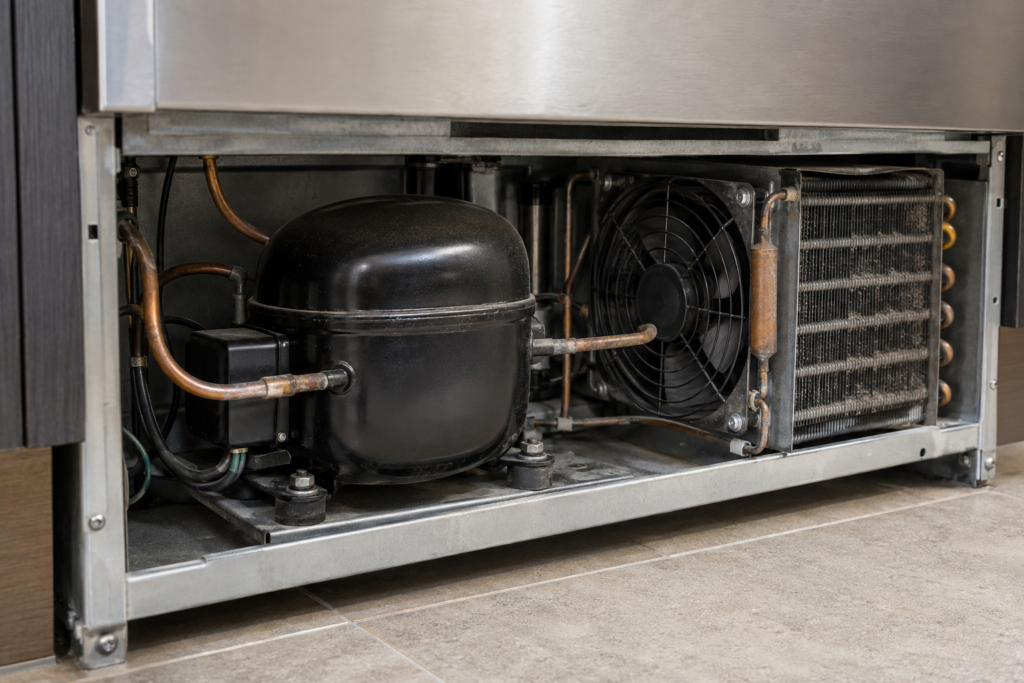
Signs That Point to the Compressor, Not Something Cheaper
"Not cooling" on its own tells you almost nothing — that same complaint spans a door seal repair from $135 and a compressor and coil job from $895, and guessing between them from the symptom alone is how owners end up either overpaying for an unnecessary diagnostic or underestimating a real compressor failure. A few signs point specifically toward the compressor rather than a door seal, or a sensor fault such as E5, cabinet thermistor shorted, which can mimic a "not cooling" complaint without actually being the compressor.
- The compressor runs constantly without ever cycling off, working harder than normal to reach a temperature it still cannot hold.
- A humming or clicking sound comes from the compressor compartment, sometimes followed by the unit shutting off entirely.
- The unit is warm throughout, not just near the door — a seal issue usually shows as warmth concentrated near the affected door, while a compressor issue affects the whole cabinet evenly.
- The exterior near the compressor compartment feels unusually hot to the touch, beyond normal operating warmth.
Why the Unit's Age Changes the Price
Because the older the cabinet, the more likely the evaporator coil needs attention at the same time as the compressor, and that turns a single-part repair into a two-part job. A unit under eight years old with a failed compressor almost never needs the coil touched — the compressor is simply the part that failed first. Past fifteen years, enough wear has accumulated elsewhere in the sealed system that a technician doing compressor work will often find the coil itself is due for replacement too, which is reflected in the higher starting price for older units.
Is It Worth Fixing the Compressor on an Older Unit?
Usually yes, even on a freestanding unit where a straight replacement is easier to compare against than it is with a built-in. A repair starting from $795, or from $895 on an older unit needing coil work too, still tends to favor repair against the cost of a comparable new U-Line unit plus removal and installation, unless the same cabinet has already needed a separate major repair recently. The calculation shifts toward replacement only when compressor work would be the second significant repair within a short window, which suggests the rest of the sealed system is also nearing the end of its service life.
Think of it this way: a fifteen-year-old cabinet with one failed compressor is still, mechanically, a cabinet with one failed part. The shelving, the door, the cabinet insulation, and the control system typically have years of service left in them regardless of the compressor's age, which is exactly why replacing the whole unit over a single compressor failure rarely makes financial sense on its own.
What Actually Drives the Final Number
- Whether the coil needs replacing alongside the compressor, which is the single biggest factor in the final price.
- Built-in versus freestanding access, since a built-in unit sometimes requires more disassembly to reach the compressor compartment.
- Confirming the diagnosis first — a unit that is simply not cooling due to a door seal from $135 or a non-compressor fault from $245 should never be quoted at compressor-level pricing without that confirmation.
- Refrigerant type and system size, which affects the recharge portion of the job.
An appliance diagnostics visit is what actually separates these scenarios instead of guessing from the symptom alone, and the written estimate that follows never changes without your sign-off. For the freezer side of a U-Line lineup rather than the refrigerator, U-Line freezer repair cost factors covers the equivalent breakdown, and general upkeep that reduces strain on the compressor over time is covered in U-Line refrigerator maintenance. When you are ready to book a diagnostic, schedule a visit or contact us with questions first.
Does a Warranty Cover Any of This?
Sometimes, depending on the age of the unit and what coverage was purchased at the time. Sealed-system components including the compressor sometimes carry longer coverage windows than the rest of the appliance on certain U-Line models, which is worth checking before assuming the full repair cost applies. U-Line warranty coverage covers how to check what applies to a specific unit before booking a compressor repair, since a covered repair changes the math on this page entirely.
What Should You Tell the Technician Before They Arrive?
- How the unit is behaving — running constantly, cycling normally but not cooling, or making unusual noise.
- How warm the interior actually is, and whether that warmth is even throughout or concentrated near one door.
- The unit's age and any prior repair history, especially anything involving the sealed system.
- Whether the unit is built-in or freestanding, since that changes both access and the replacement comparison.
Having these details ready before the visit does not change the diagnostic step itself, but it does mean the technician arrives with a reasonable idea of what to expect rather than starting from zero, which can shorten the visit and, occasionally, the parts wait if a compressor needs to be ordered in advance based on the symptom pattern described.
None of this replaces an actual diagnostic visit, and that is by design — a compressor is expensive enough that ordering one on a guess, rather than a confirmed test, risks a wasted trip and a second wait if the guess turns out wrong. The goal of describing the symptoms accurately is to make that one confirmed visit as efficient as possible, not to skip it.