 Ryan Caldwell
Key Takeaways
- The serial number from the rating plate anchors everything — paperwork can be reconstructed, a missing serial cannot.
- We are an independent repair guide and cannot quote your terms: coverage is defined by the documentation that shipped with your model.
- Coverage is written around defects, so maintenance consequences and installation problems are usually treated as owner responsibility.
- Photograph the display code before clearing it; a documented fault is much stronger evidence than a description.
- Do not authorize paid work before you know who handles the claim — self-funded repairs are rarely reimbursed later.
The Bottom Line
Gather the rating plate photograph, the purchase paperwork and a written description of the fault before you call anyone, because those three decide how fast a claim moves. If the unit turns out to be uncovered, a diagnostic still tells you what failed before you commit to a repair.
Something has failed in a built-in cabinet that was not cheap, and the first question is whether you are about to pay for it. Before that can be answered, four pieces of information have to exist, and in most households at least two of them are missing. This guide is about assembling them — not about what any particular U-Line warranty says, because that is set by the documents that came with your unit and by the date it was installed, and neither of those is something we can read for you.
| What you need | Where it lives | Why it matters |
|---|---|---|
| Model and serial number | Rating plate on the unit | Identifies the platform and the build date |
| Proof of purchase | Dealer invoice or closing paperwork | Establishes when coverage started |
| Installation date | Builder or installer records | Often differs from the purchase date |
| Registration, if it was done | Your own records | Speeds a claim, and sometimes conditions it |
| Written description of the fault | Your notes and photographs | Decides whether it is a covered failure |
Start With the Rating Plate, Not the Paperwork
The serial number is the anchor for everything else. It identifies the platform, which decides which parts fit and which service documentation applies, and it carries the information a manufacturer uses to place your unit in time. Paperwork can be reconstructed. A missing serial number cannot.
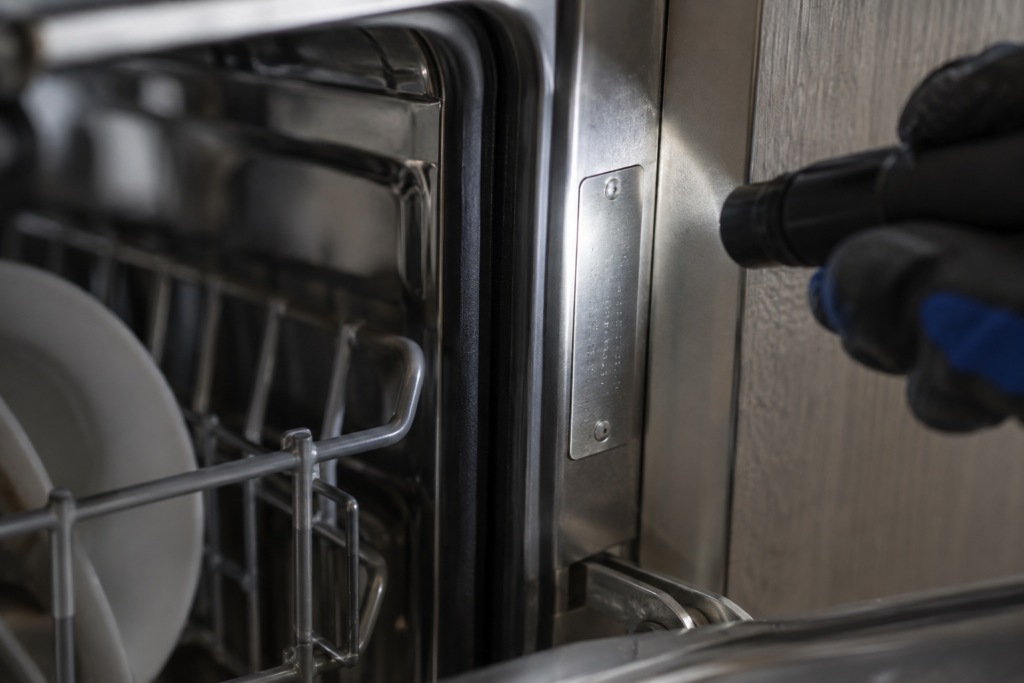
On a built-in undercounter cabinet the plate is usually on the inner door frame or along a side wall near the front, and it is often awkward to see. Take a flashlight, open the door fully, and photograph it rather than copying it out by hand — serial numbers are long, and a transposed character sends you back to the cabinet on your knees.
A Word About Who We Are
This site is an independent repair guide. We are not affiliated with the manufacturer, we do not administer anyone's coverage, and we are not going to quote you terms, periods or exclusions that we have not read. A U-Line warranty is defined by the use-and-care documentation that shipped with your specific model and by the conditions of its sale, and those vary by product family and by how the unit was bought.
What we can tell you is how the process works in practice, what makes claims go smoothly, and where the common traps are. That is what the rest of this guide covers.
It is also worth saying plainly that nobody should be asked for money over the phone before a unit has been looked at. If a cabinet is covered, the claim decides who pays. If it is not, the diagnosis decides what the repair is. Neither of those can be settled from a description of the symptom, however detailed.
Where the Line Usually Falls
Coverage is written around defects. The distinctions that decide most cases in practice are these:
- A failed component is one thing, a maintenance consequence is another. A condenser that was never cleaned, an ice machine that was never descaled, a unit installed with no clearance — those outcomes are usually treated as owner responsibility.
- Installation matters more here than on a freestanding appliance. A built-in cabinet strangled for airflow will fail early, and the failure traces back to the cavity, not to the machine.
- Cosmetic damage is rarely treated like a functional fault. Scratches and dents are usually a delivery conversation, not a service one.
- Prior work by an unauthorized party complicates things. If a component has already been swapped, expect that to be raised.
- Codes are evidence. A display fault such as E1, cabinet thermistor open documents a component failure far better than "it stopped cooling" does.
Running a Claim Without Losing Time
The sequence that wastes the least time is the same every time. Gather the plate photograph and the purchase paperwork first. Write down what the unit is doing, when it started, and any code on the display — before clearing it. Photograph the installation too, including the grille and the surrounding cabinetry, because that answers the airflow question before anyone asks it.
Then find out who is meant to handle the claim for your unit. That is whoever the documentation names, and it depends on how the cabinet was purchased — through a dealer, as part of a build, or from a retailer with its own plan. Do not authorize paid work until you know: a repair you pay for yourself is rarely reimbursed afterward, even when the fault would have been covered. Our warranty and parts service exists for exactly this handover, and we would rather tell you that a visit is not worth booking than take one that should have gone through a claim.
Keep your own record of the claim as it moves. Dates, who you spoke to, what was agreed, and what part was ordered. Built-in appliances often need a second visit simply because a component has to come from a distributor, and a written trail makes the gap between the two visits much easier to manage. It also protects you if a fault returns after the work.
When the Answer Is No
Plenty of these cabinets outlive their coverage by many years, and being out of warranty is not the same as being past repair. The useful question then is what the fault is, before you decide anything. A diagnostic answers that, and work on these platforms starts from $75, with sensor and sealed-system diagnosis higher.
The final price is always confirmed after the on-site diagnosis, and you receive a written estimate before any work begins. Our diagnostic service exists to produce one answer rather than a list of possibilities, and our guide to U-Line refrigerator repair cost factors sets out what drives the number afterward. If you are unsure which side of the line you are on, send us the model number and what the unit is doing, or book a visit and we will tell you what we find.