 Ryan Caldwell
Key Takeaways
- WARM-ZN is a documented U-Line service symptom for a storage zone that is too warm, and it never appears as a code on the display.
- A blocked front grille or a dust-packed condenser coil is the most common cause and the cheapest one to rule out.
- A gasket that no longer seals lets warm room air in continuously and brings frost and humidity problems with it.
- If E1 or E5 shows alongside the warm zone, the cabinet thermistor circuit is involved and cleaning will not help.
- Give the cabinet a full day after any correction — wine holds heat and recovery is slow.
The Bottom Line
Clear the grille, clean the condenser and check the door gasket before touching the setpoint, because those three account for most warm-zone complaints. If the zone is still warm a day later, or a sensor code is showing, it needs testing rather than adjustment.
The bottles on the top shelf feel closer to room temperature than to cellar temperature, the display shows nothing unusual, and the cabinet sounds like it always has. In U-Line documentation this has a name — WARM-ZN, storage zone too warm — and it is one of the most common service symptoms on the wine platforms. The important thing to understand first is that it is not a code you will ever see on the screen.
| What you notice | Most likely cause | First move |
|---|---|---|
| One zone warm, cabinet otherwise normal | Restricted airflow at the grille | Clear the front grille and the condenser behind it |
| Warm near the door, cold at the back | Door not sealing | Inspect the gasket along its whole run |
| Warm after a hot day or a party | Recovery load, not a fault | Give it a full day undisturbed |
| Warm and the compressor runs constantly | Condenser fouled or fan weak | Book a diagnostic |
| Warm with E1 or E5 on the display | Cabinet sensor circuit | Sensor testing, not adjustment |
What U-Line Wine Cooler WARM-ZN Actually Is
U-Line troubleshooting and use-and-care guidance treats a storage zone that is too warm as a genuine service symptom in its own right, with its own checks. The site records it as WARM-ZN, and the entry says something worth repeating: no dedicated electronic code is shown. The tag is how the condition is classified in service documentation, not something the control board prints for you.
That distinction matters because it changes how you search and how you describe the problem on the phone. There is no code to clear and no reset that means anything here. What you have is a cabinet that is not holding its set temperature, and the way forward is to eliminate the ordinary causes in order before anyone talks about sealed-system work.
Airflow Comes First, Every Time
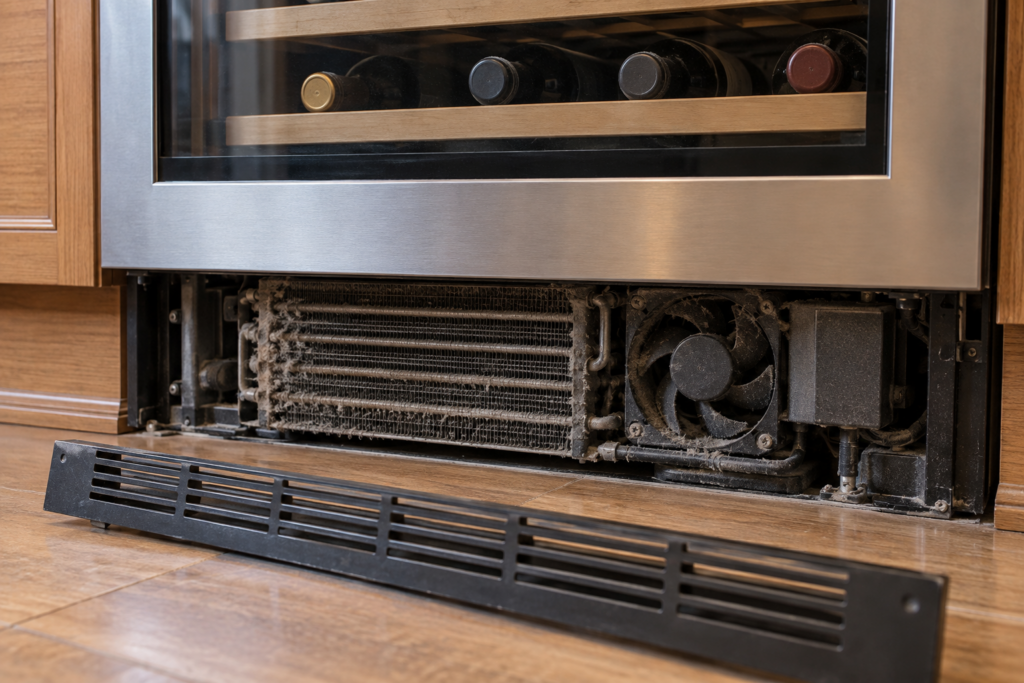
A built-in wine cooler breathes through the grille at the bottom of the door. Air is pulled in, drawn across the condenser coil, and pushed back out through the same opening. There is nowhere else for that heat to go — unlike a freestanding unit, a built-in cabinet is boxed in on five sides by the cabinetry itself.
So the grille is not decoration. When it is blocked by a rug, a kick panel that was reinstalled too tightly, or several years of dust and pet hair in the coil behind it, the condenser cannot shed heat. The compressor keeps running, the cabinet keeps losing ground, and the zone furthest from the evaporator drifts warm first. This is the single most common cause we find, and it is also the cheapest one to rule out.
- Look at the grille before you touch a setting. If you cannot feel warm air coming out of it while the unit runs, you have found the problem.
- Vacuum the coil, do not just wipe the grille. The dust that matters is behind the opening, packed into the fins.
- Leave the clearance the installation asked for. A cabinet cut tight around the unit strangles it quietly.
- Check the fan is turning. A condenser fan that has stalled produces exactly this symptom with no other warning.
U-Line documents fouled coils separately as CONDENSER — condenser needs cleaning, and cleaning work of this kind starts from $75. Our wine cooler maintenance guide covers how often it is worth doing.
The Door Is the Second Suspect
Wine cabinets get opened and closed by people holding bottles, and doors take the consequences. A gasket that has taken a set, a hinge that has dropped a fraction, or a shelf pushed forward far enough to hold the door off its seat will all let warm room air in continuously.
Run a finger along the full perimeter of the gasket with the door closed and feel for a draft. Then open the door and look at the gasket itself: folds, flat spots, and hardened corners are all visible once you know to look. A door that is not sealing is documented on its own as DOOR-SEAL, and that repair starts from $120. It is worth fixing promptly — a leaking door does not just warm the cabinet, it drives humidity and frost problems as well.
When the Display Does Have Something to Say
If a code appears alongside the warm zone, the diagnosis changes. On the wine platforms E1 means Cabinet Thermistor Open and E5 means Cabinet Thermistor Shorted. Both describe the sensor the control board uses to decide whether the cabinet is at temperature. A failed cabinet sensor can leave a compressor idle while the wine warms, and no amount of cleaning will change that.
Sensor circuit work on this platform starts from $120. It is not a guess-and-replace job: the probe, its harness and the board all have to be tested together, because a shorted reading and an open reading can come from the wiring rather than the sensor itself.
Getting It Checked
Give the cabinet a full undisturbed day after cleaning the grille and checking the door. Wine has a lot of thermal mass, and a cabinet that has been fighting a blocked coil for weeks does not come back to temperature in an hour. If the zone is still warm the next day, stop adjusting the setpoint — that only masks the measurement.
Our U-Line wine cooler repair service tests the airflow path, the door seal, the sensor circuit and the sealed system in one visit, which matters here because the symptom is the same whichever of them is at fault. Work on a warm storage zone starts from $100, the final price is confirmed after the on-site diagnosis, and you receive a written estimate before any work begins. You can book a visit once you know which of the checks above you have already ruled out.