 Ryan Caldwell
Key Takeaways
- Five U-Line wine cooler entries are real display codes, E0, E1, E2, E5 and E6, and five more are service symptoms that never appear on the display.
- E1 and E5 are the cabinet thermistor, open and shorted, and E2 and E6 are the evaporator thermistor, open and shorted.
- A shorted or open reading can come from the wiring or the board rather than the sensor, so test the circuit before buying a part.
- The same E-code numbering is used on this site for wine fridges, refrigerators and freezers, but ice makers use a different list.
- Resetting once is fine, but repeated power cycles hide the pattern, and warming wine is the signal to stop and book service.
The Bottom Line
Sort your cabinet into the display codes or the symptoms with no code, check the door, airflow and cleanliness, and put a thermometer inside. If the same problem returns, book a diagnostic instead of resetting again.
U-Line wine cooler troubleshooting starts with knowing that the entries come in two kinds, and mixing them up is the most common reason owners cannot find what their cabinet is telling them. Five of the entries on this site are real codes that appear on the display: E0, E1, E2, E5 and E6. The other five, WARM-ZN, LIGHT, VIBE, DOOR-SEAL and CONDENSER, are service symptoms named in U-Line's documentation that never show up on the display at all. If you are staring at a clean screen and a warm cabinet, the answer is probably in the second group.
| Code or symptom | What it reports | On the display? | Site estimate of DIY share |
|---|---|---|---|
| E0 | Door open alert | Yes | About 45 percent |
| E1 | Cabinet thermistor open | Yes | About 65 percent |
| E2 | Evaporator thermistor open | Yes | About 55 percent |
| E5 | Cabinet thermistor shorted | Yes | About 60 percent |
| E6 | Evaporator thermistor shorted | Yes | About 50 percent |
| WARM-ZN | Storage zone too warm | No | About 45 percent |
| DOOR-SEAL | Door not sealing properly | No | About 55 percent |
| CONDENSER | Condenser needs cleaning | No | About 65 percent |
| VIBE | Vibration concern | No | About 60 percent |
| LIGHT | Display or light concern | No | About 50 percent |
What Do the E-Codes on a U-Line Wine Cooler Mean?
E0 is a door open alert, and the other four describe the two temperature sensors inside the cabinet. The numbering follows a pattern that makes the list easy to hold in your head: the cabinet thermistor is E1 when its circuit is open and E5 when it is shorted, and the evaporator thermistor is E2 when open and E6 when shorted. The site's wording follows official U-Line service documentation, which uses the same numbers for each.
- E0, door open alert — the door has been left open or is not closing fully, and it is the one code that is not about a sensor.
- E1 and E5, cabinet thermistor — the sensor the board uses to decide whether the cabinet is at temperature.
- E2 and E6, evaporator thermistor — the sensor that watches the cold surface that does the cooling.
- The pattern repeats on other platforms — wine fridges, refrigerators and freezers on this site use the same E0, E1, E2, E5 and E6 meanings.
The ice maker is the exception. It numbers its codes differently, E0 through E4, with a refrigerator and a freezer thermistor among them, so a code from an ice maker should be read on U-Line ice maker error codes, not here. Each wine cooler code also has its own page, such as wine cooler E5 and wine cooler E1.
What Is the Difference Between an Open and a Shorted Thermistor?
An open thermistor circuit is a break, so the control board receives no reading, while a shorted one gives a reading that is impossibly extreme. Either way the board cannot trust the sensor, and the cabinet may run warm or cold without the control being able to correct it. The site is careful about one point: a shorted reading and an open reading can come from the wiring rather than from the sensor itself, so the probe, the harness and the board have to be tested together.
- Do not buy a sensor on the strength of the code alone — a wiring or connector fault produces the same code.
- Match the code to your exact model first — the site stresses that a code points to a model-specific condition.
- Note whether a warm zone came with it — a sensor code beside a warm cabinet means cleaning will not fix it.
Which Wine Cooler Problems Never Show a Code?
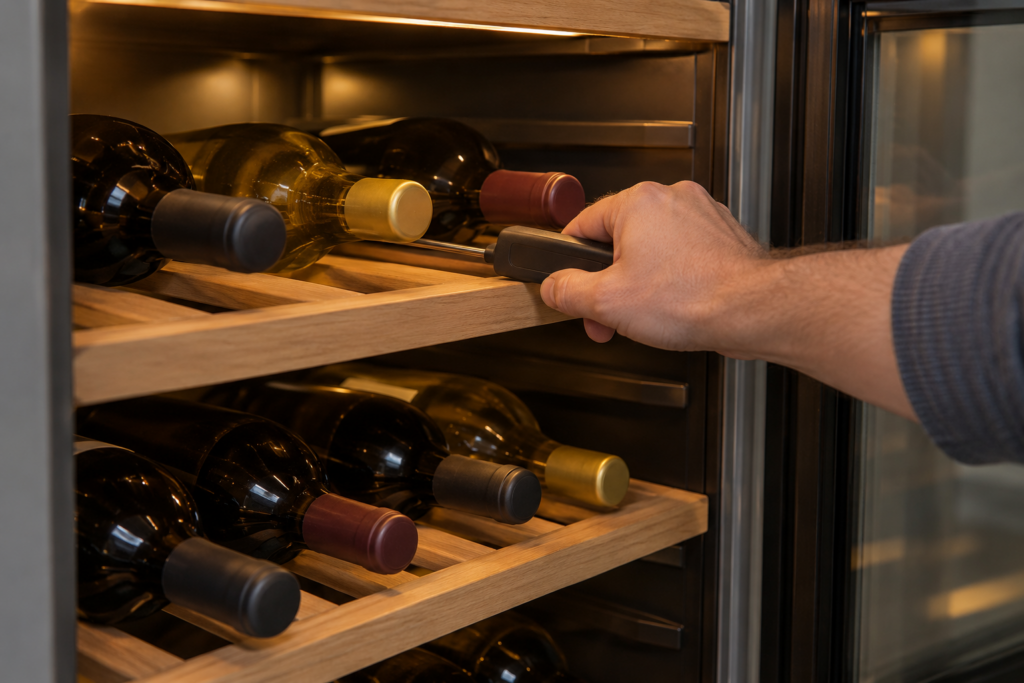
WARM-ZN, LIGHT, VIBE, DOOR-SEAL and CONDENSER are classified in U-Line documentation as real service symptoms, and the entries say plainly that no dedicated electronic code is shown. There is nothing to clear and no reset that means anything: what you have is a cabinet that is behaving differently, and the way forward is to rule out the ordinary causes in order.
- WARM-ZN — a storage zone that will not hold temperature, and the airflow and gasket checks come before any setting change.
- CONDENSER — dust built up in the condenser, which strangles the airflow a built-in cabinet depends on.
- DOOR-SEAL — a gasket that no longer closes, which lets warm air in continuously.
- VIBE — racks or bottles that vibrate, treated with the same first checks of sealing, airflow and levelness.
- LIGHT — a display or interior light concern, listed separately from the temperature faults.
The warm-zone symptom has its own guide, U-Line wine cooler WARM-ZN, and the wider list of causes is in U-Line wine coolers not working.
Can You Reset a U-Line Wine Cooler Code?
Yes, a restart can clear a temporary state, and the site rates every code in this list as safe to keep using while the wine is still being kept properly. But a recurring issue still needs a proper diagnosis, and the advice on every page is the same: do not keep power-cycling the cabinet after the same problem has come back. Repeated resets hide the pattern the technician needs to see.
- Check the basics. Look at door sealing, airflow and cleanliness before anything else, since these are the most repeated first-line checks in U-Line documentation.
- Put a thermometer in the cabinet. A reading of the real temperature tells you whether the wine is at risk, whatever the display says.
- Restart once. If the code clears and stays away, note the date and move on.
- Stop if the wine is warming. Move the bottles to a cool place and book service when stored product is no longer being kept correctly.
The code does not mean the cabinet should be switched off by itself. The stop signs are practical: stored wine that is warming, water leaking, or recurring alerts together with heavy frost. For regular care, the routine in U-Line wine coolers maintenance keeps most of the symptom group from appearing.
How the Wine Fridge Platform Differs
This site documents two U-Line wine platforms separately, the wine cooler and the wine fridge. The wine fridge shares the E0, E1, E2, E5 and E6 meanings, so the table above applies to its display codes as well. Where it differs is in the symptom group, which for the wine fridge reads DOOR-ALERT, DUAL-ZN, RACK-VIBE, TEMP-DRIFT, LIGHT and CONDENSER.
- DUAL-ZN — two zones that no longer hold their separate temperatures.
- TEMP-DRIFT — a wine fridge running warm without a code on the display.
- DOOR-ALERT — a door alert that repeats, listed apart from the E0 display code.
- RACK-VIBE — racks or bottles that vibrate in the cabinet.
If your cabinet is a wine fridge rather than a wine cooler, start from the matching pages, such as wine fridge E5 and U-Line wine fridge dual zone. The rating plate settles which platform you own, and matching the code to the exact model before ordering a part is the advice every code page repeats.
When to Book a Technician
Book when the same code returns after the basics, when the zone is still warm a day after cleaning the condenser and checking the door, or when a sensor code shows with a warm cabinet. The visit tests the airflow path, the door seal, the sensor circuit and the sealed system together, which matters because the symptom is the same whichever of them is at fault. Our U-Line wine cooler repair service covers it, and the final price is confirmed after the on-site diagnosis, with a written estimate before any work begins. Schedule a visit or tell us the code, the model and what the cabinet is doing.