 Ryan Caldwell
Key Takeaways
- U-Line built cabinets across several generations and widths, so gaskets, shelves, fans and sensors are model-specific — the rating plate comes first.
- Gaskets, shelves, condenser coils and condenser fans are the genuine wear items on a wine cabinet.
- A thermistor is cheap but expensive to guess at: E1 and E5 can both come from the harness rather than the probe.
- On a built-in cabinet, access is most of the labor, which is why testing beats swapping parts in sequence.
- If the unit is still covered, parts should go through the warranty channel rather than a parts counter.
The Bottom Line
Photograph the rating plate before you shop for anything, because U-Line parts are matched to a platform and a near-fit gasket or shelf is a wasted order. Sensors and boards should be tested rather than replaced on the strength of a code.
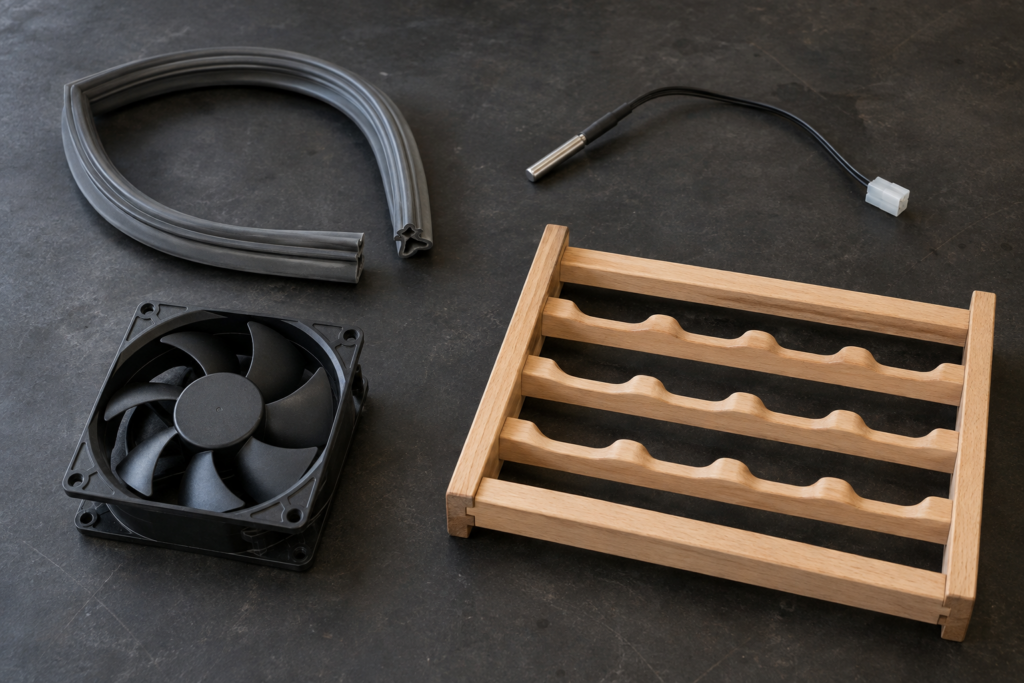
Most people who go looking for U-Line wine cooler parts are really trying to answer a different question: is the thing that failed cheap or expensive, and can it be dealt with at all? On a built-in wine cabinet the answer depends far less on the price of the component than on where it sits and what has to come apart to reach it. Here is how the parts on these units actually group up.
| Part | The symptom that points at it | Service starts |
|---|---|---|
| Condenser coil and grille | Cabinet warm, compressor running constantly | from $75 |
| Shelves and rack hardware | Rattle or bottle vibration at rest | from $75 |
| Cabinet thermistor | E1 or E5 on the display, wrong readings | from $100 |
| Door gasket and hinge | Warm near the door, frost, condensation | from $120 |
| Condenser fan | Silence where there was airflow noise | from $120 |
Nothing Happens Before the Rating Plate
U-Line has built undercounter cabinets across several generations and widths, and the platforms do not share every component. A gasket profile, a shelf, a thermistor and a fan are all model-specific enough that ordering by eye is a way to buy the wrong thing twice.
The rating plate carries the model and serial number, and on a built-in cabinet it usually lives on the inner door frame or along the side wall near the front. Photograph it. That photograph is the single most useful thing you can have before you talk to anyone about parts, and it is the fastest way to end the guessing about which generation you own.
The Parts That Are Genuinely Wear Items
A wine cabinet has a short list of components that are expected to age, and owners can reason about all of them without opening anything.
- The door gasket. It takes a set over the years, and the corners harden first. A gasket that no longer seals is documented as DOOR-SEAL, and it causes warm zones, condensation and frost all at once.
- Shelves and their runners. Wooden racks and their glides are the parts most often damaged, usually by loading, and they are also the parts most often simply missing after a move.
- The condenser coil. Not a part you replace so much as one you maintain. Left alone in a built-in cavity it fills with dust, and every other symptom follows from that.
- The condenser fan. Bearings do wear. A fan that has stopped turning presents as a cabinet that will not hold temperature, with no noise to warn you.
- Interior lighting. Cosmetic, cheap, and worth mentioning to a technician who is already coming out rather than booking separately for it.
Sensors and Boards Are a Different Conversation
A thermistor is an inexpensive component that is expensive to get wrong. The control board reads it to decide whether to cool, so a probe reading badly will produce symptoms all over the cabinet. On the wine platforms E1 means Cabinet Thermistor Open and E5 means Cabinet Thermistor Shorted — two faults that can equally be caused by the harness between the probe and the board rather than by the probe itself.
That is why we do not recommend buying a sensor on the strength of a code. Testing the circuit costs a fraction of replacing the wrong half of it, and on a built-in cabinet the labor to reach a probe is most of the job. The same logic applies to a control board, which is the most expensive single component in the unit and the one most often replaced unnecessarily.
There is one more reason to test rather than replace. A board that is swapped into a cabinet with a shorted harness will often fail the same way within weeks, and the second board is never covered by the first repair. Confirming the circuit before ordering is not caution for its own sake — it is the difference between one visit and three.
Where Parts Come From, and What That Changes
If the cabinet is still covered, parts and labor should go through the warranty channel rather than through a parts counter — a repair paid for out of pocket rarely gets reimbursed afterward, and self-installed components can complicate what remains of the coverage. Our warranty and parts service handles that side, and the first step is always the model and serial number from the plate.
Outside of warranty, the practical difference between a genuine component and a generic equivalent is fit. Gaskets, shelves and fans are dimensional parts: a near-match sits proud, leaks, or rattles. For sensors and boards, the electronic match matters more than the physical one. Our guide to U-Line wine cooler repair cost factors goes through how labor and access shape the final number.
What a Visit Actually Costs
Work on these cabinets starts from $75 for cleaning and access-level jobs and from $120 where a sensor circuit or a sealed component is involved. Those are starting figures, not quotes: the final price is confirmed after the on-site diagnosis, and you receive a written estimate before any work begins.
- Photograph the rating plate. Model and serial, in focus, before anything else.
- Write down what the cabinet is doing. Warm where, how quickly, with or without a code.
- Do not order parts on a guess. A returned part still costs you the wait.
- Ask what caused the failure. A gasket replaced without fixing a dropped hinge will fail again.
One more note on sourcing. Shelves, gaskets and grilles turn up secondhand from owners parting out an old cabinet, and for purely dimensional parts that can be a reasonable route if the model matches exactly. Electrical components are a different matter: a used sensor or fan carries an unknown history and no way to verify it, and on a built-in unit you pay the access labor again when it disappoints.
Bring those first two items to the conversation and most of the uncertainty disappears. You can book a visit once you have them, and a technician can confirm which component is actually involved before you spend anything on it.