 Ryan Caldwell
Key Takeaways
- Most U-Line wine fridge vibration is an installation or loading problem: level, racks, bottle contact or something touching the cabinet.
- The RACK-VIBE page lists about 60 percent of cases as owner-fixable and points to sealing, airflow, cleaning and levelness first.
- Level the cabinet, reseat and tug each rack, space the bottles and keep the grille and condenser clear.
- Avoid wedging bottles with towels or foam, and avoid restarting the unit as a fix for a rattle.
- Book service if the vibration persists after the checks, becomes a knock or grind, or temperature starts to drift.
The Bottom Line
Wine fridge vibration is usually fixed with a spirit level and a minute with the racks. Check level, racks, bottle spacing and contact each season, and call only if it persists.
A wine fridge is supposed to be the quietest thing in the kitchen, so a rattle, a hum you can feel through the counter, or bottles that chatter against each other registers at once. U-Line wine fridge vibration is rarely a sign of a failing compressor. This site's RACK-VIBE page, for racks or bottles that vibrate, points first at the things an owner controls: level, racks, how the bottles sit and what the cabinet touches.
| Check | How | When |
|---|---|---|
| Level | Spirit level on a shelf, front to back and side to side | After any move, and each season |
| Racks | Reseat each rack and tug it gently | Each season |
| Bottles | Make sure necks and shoulders are not touching each other or the liner | When restocking |
| Surroundings | Look for panels, trim or items touching the cabinet | After cabinet work |
| Grille and condenser | Keep the front clear and the condenser dust-free | Twice a year |
What Causes U-Line Wine Fridge Vibration?
Most of it is an installation or a loading problem, not a mechanical one. The page for racks and bottles that vibrate is the more reassuring end of this site's list: it carries a high owner-fixable share, about 60 percent, and the first checks are the ones U-Line documentation keeps coming back to, which are sealing, airflow, cleaning and levelness.
A wine fridge makes a little noise by design, because it has a compressor and a fan. Vibration is what you hear when that small motion finds something to rattle: an unlevel cabinet, a loose rack, a bottle leaning against the liner, or a trim panel that touches the side. Remove the path and the sound usually goes.
Start With Level
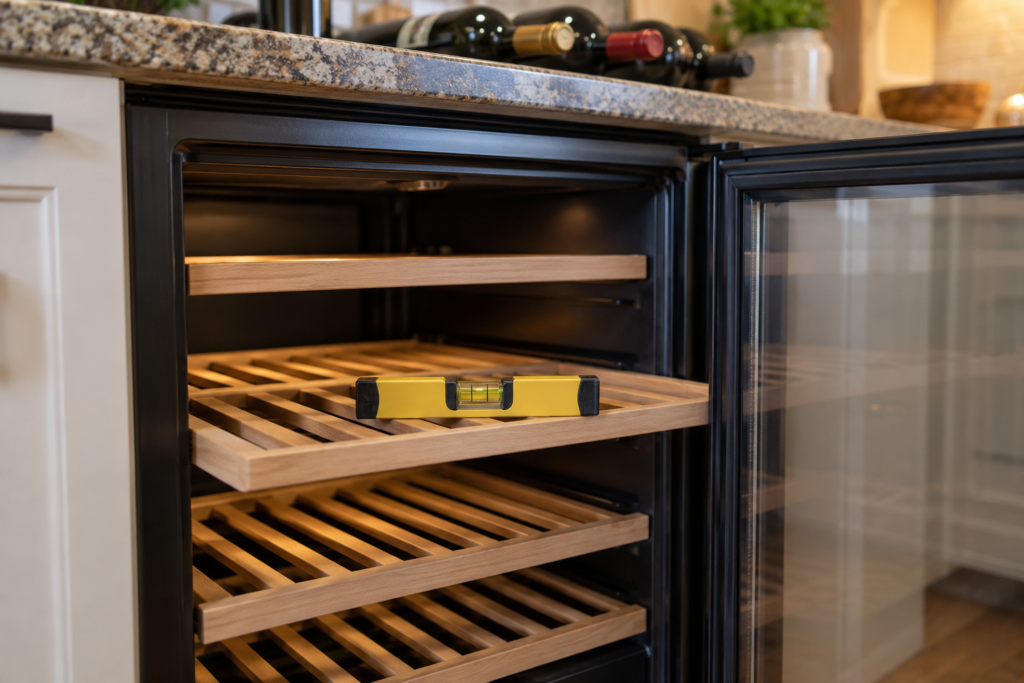
An unlevel cabinet is the most common single cause, and the check takes two minutes. Lay a spirit level on a shelf inside the open cabinet, once front to back and once side to side, and adjust the feet until both read level. On built-in models the adjustment is usually reachable from the front.
Check again after any move and after any work to the floor or the cabinetry around the unit, because settling and remodeling both shift the cabinet by small amounts. A cabinet that is only a little off can still load the compressor mounts unevenly and amplify normal vibration.
Racks, Bottles and Contact
Racks are the second suspect, and bottles are the third. A rack that has worked loose from its mounting points rattles at the compressor's rhythm even if the compressor is fine, and bottles that touch each other or the liner turn a faint hum into a chatter.
- Reseat each rack fully into its slots and tug it gently to confirm it is locked.
- Check for worn or broken rack pins, and replace a rack that will not hold firm.
- Space the bottles so they do not touch each other or the cabinet wall.
- Do not wedge bottles with towels or foam, which can block airflow and trap moisture.
Contact is the fourth suspect. A built-in wine fridge can pass its own vibration to anything it touches. Look for cabinet panels, trim, a countertop overhang or stored items pressed against the unit's sides or top. Even a small contact can resonate like a drumskin, and it is easy to miss because it only shows up when the compressor runs. If the noise started after cabinet work, a shifted panel is a prime suspect.
Keep the front grille clear as well. The site's condenser page for wine fridges links airflow and cleanliness to normal operation, and a dusty condenser makes the fan and compressor work harder, which raises both noise and vibration. Our wine fridge maintenance guide covers the cleaning routine.
Does Vibration Harm the Wine?
Constant or strong vibration is a reasonable thing to avoid for bottles you intend to age, as many collectors prefer, while ordinary light hum is part of any refrigerated cabinet. The site's page does not give a threshold, so treat vibration you can feel with a hand on the door as the point to act on.
For wines you will drink within months, the practical cost is mostly noise and the annoyance of a rattling cabinet. For long-term bottles, take the checks more seriously, and consider moving the most valuable ones until the cause is found. Our wine fridges safety guide covers keeping a collection safe.
A Seasonal Routine That Prevents It
Four short steps, done each spring and fall, keep most vibration from starting.
- Level the cabinet and check the feet for movement.
- Reseat and tug each rack while the cabinet is partly empty.
- Space the bottles as you restock, so no neck or shoulder touches another or the liner.
- Clear the grille and dust the condenser, following the cleaning guidance for your model.
Avoid the temptation to keep restarting the unit. The pages say recurring problems need diagnosis, not endless restarts, and a restart does nothing for a rattle.
Quick Fixes You Can Try Tonight
If the noise is bothering you now, a few changes take minutes and cost nothing. Do them one at a time, so you can tell which one worked and remember it for the next season.
- Press a hand on the top and sides while the compressor runs; if the sound changes, something is in contact or a panel is resonating.
- Remove any item resting on top of the unit, including a bottle, a tray or a decorative object that can buzz.
- Take out the bottles from one shelf and listen; a chatter that stops tells you the bottles were the cause.
- Move the cabinet a fraction away from an adjacent panel if you can do so safely and the installation allows it.
Write down what you tried and what happened. If you do end up booking a visit, that note is worth more to the technician than a description of the sound, because it rules out the causes that cost nothing.
When Is It More Than Maintenance?
It is more than maintenance when the vibration persists after the checks, when the sound is a knock or grind, or when the cabinet is also failing to hold temperature. The pages list a same code or symptom returning after basic checks, and an issue that now affects real storage performance, as the reasons to call. The RACK-VIBE page lists a typical repair cost from $75, and the wine fridge repair page confirms pricing only after the model and fault are diagnosed, with a written estimate first.
The similar VIBE page for wine coolers is at wine cooler VIBE, and the wine fridge page itself is RACK-VIBE. If temperature has started to wander too, read our guide to a wine fridge dual zone not holding. To have it checked, schedule a visit and say what you already tried.