 Ryan Caldwell
Key Takeaways
- Clean the condenser and clear the front airflow before suspecting the fan motor.
- A failed motor is replaced; cleaning, clearing an obstruction and fixing a connector are the real repairs.
- A motor that turns slowly or noisily is better replaced before it fails during a warm spell.
- A fan that cannot move air makes the compressor run hot, so a prompt repair protects the expensive part.
- Compare the estimate with replacement only if the compressor or the cabinet is also in question.
The Bottom Line
A condenser fan motor is a wear part. Clean and clear first, replace a failed motor on an otherwise sound machine, and weigh replacement only when other major parts are also failing.
A U-Line that runs all day and never quite gets cold is often fighting its own heat. The condenser is the part that sheds it, and where a fan pulls room air across the coil, the fan motor decides how well that works. When the motor is the suspect, owners face a narrow choice of U-Line condenser fan motor repair or replace, and the useful answer depends on what the technician actually finds. The whole-appliance version of this choice is in our U-Line refrigerator repair-or-replace guide; this one deals only with the fan.
| What the technician finds | Path | Why |
|---|---|---|
| Fan blade clogged with lint or touching debris | Clean and clear it | The motor is sound; something is in its way |
| Motor not turning, winding or bearing failed | Replace the motor | A worn motor is a wear part, not a repair |
| Motor turns slowly or noisily | Replace it before it fails | A tired motor often fails during the next warm spell |
| Fan fine, condenser matted with dust | Clean the condenser | The airflow problem was never the motor |
| Motor failed and the compressor has overheated | Compare with replacement | The cost of the secondary damage changes the decision |
What Does a Condenser Fan Motor Do in a U-Line?
It moves room air across the condenser so the refrigeration system can get rid of the heat it removes from the cabinet. Where a unit has one, it works together with the front grille, which provides the intake and exhaust path, and a clean condenser, which gives the air something to carry heat away from.
That is why this site's troubleshooting material starts with the grille and the condenser instead of with parts. U-Line's own guides stress front airflow, condenser cleanliness and level installation as the first checks for any warm cabinet, and our grille clearance notice says the grille must stay installed and unobstructed.
How Do You Know the Fan Motor Is the Problem?
You rule out the cheaper explanations first, then listen and look. The site has two condenser-related code pages, one for refrigerators and one for wine fridges, and both treat a dirty condenser as the usual cause rather than a failed part.
- Clean the condenser. Disconnect power, remove the grille and clean with a soft brush or a vacuum, as in the condenser cleaning notice. Mind the sharp fins.
- Clear the airflow path. Nothing stored against the grille, and no closed cabinet door in front of an indoor unit.
- Restore power and listen. A healthy fan is steady; a fan that is silent, ticking or grinding is not.
- Feel the air at the grille. Little or no airflow with the compressor running points at the fan.
- Note the pattern. A cabinet that gets warm in the afternoon, runs without stopping and recovers overnight is typical of a heat problem.
The refrigerator condenser page and the wine fridge condenser page describe the owner-level checks, and both say that if the basics are correct the problem is more likely tied to the specific platform.
Should the Motor Be Repaired or Replaced?
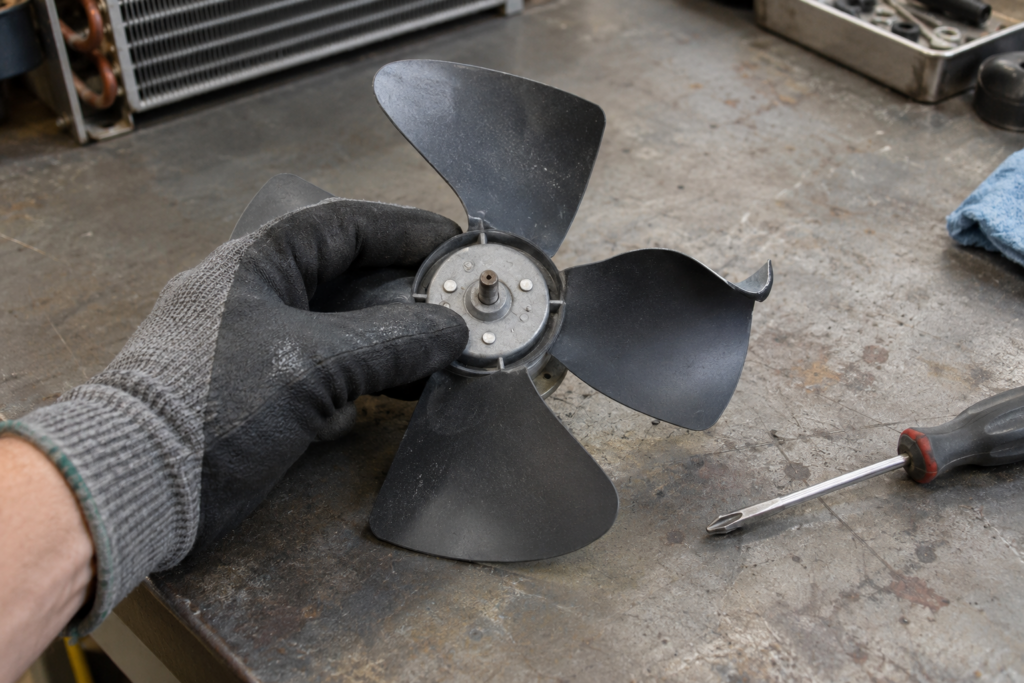
Replaced, in nearly every case where the motor itself has failed, because a small motor's bearing or winding cannot be repaired economically. The real "repair" options are the cleaning, a wiring or connector fix, and clearing an obstruction. They are worth trying first, and a technician will tell you which applies after testing.
- Clean and clear. If lint or debris is jamming the blade, removing it restores the fan.
- Connector and wiring. A loose plug or a chafed wire can mimic a dead motor.
- Replace the motor. When it will not turn, turns slowly or makes bearing noise.
- Replace the blade or shroud if it is cracked and rubbing.
Ask the technician to confirm the motor is available for your exact model and whether it is fitted as a single part, since parts are matched to the model family.
Two small habits make the diagnosis quicker. First, note whether the problem is worse at certain times of day, since afternoon heat and a hot kitchen make a marginal fan fail visibly. Second, tell the technician what you cleaned and when; a condenser cleaned that morning and a cabinet that is still warm points the diagnosis straight at the fan or the sealed system instead of at dust.
The same logic applies if you are tempted to run the unit with the grille off to "help it breathe." The grille is part of the airflow path, and operating without it can short-circuit the air the fan is meant to pull across the coil, so keep it on during normal operation.
Why Fix It Promptly?
Because a fan that cannot move air makes the compressor run hot, and the compressor is the expensive part. A warm cabinet that runs constantly is the sign that the system is losing its battle, and the longer it continues, the more likely a small repair becomes a large one. Moving perishables out early is cheap insurance while you arrange the visit.
Keep the cabinet contents safe while you wait: move anything perishable if the unit is no longer cold, and do not keep resetting it. Our guide to U-Line refrigerators not working compares other warm-cabinet causes, and the control board guide covers the other part that can look like a failing fan.
Other Warm-Cabinet Causes to Rule Out
A struggling fan is only one of several reasons a U-Line runs warm, so keep the others on the list until they are excluded.
- The door. A worn gasket or a door that does not close evenly lets warm air in; see the door seal care guide.
- The sensor. A cabinet thermistor fault, as on the E5 page, can make the control misjudge the temperature.
- The environment. A hot kitchen, direct sun or a nearby heat source makes any condenser work harder.
- The installation. An indoor unit behind a closed cabinet door cannot move air however good its fan is.
How to Decide
Treat a fan motor as a wear part on a machine that is otherwise healthy, and as a warning sign on one that is not. The motor alone is a modest repair. A motor failure together with an old compressor, a leaking cabinet or earlier warm-cabinet history is a different conversation, and the written estimate is the way to hold it.
- Clean and clear first, since it may make the replacement unnecessary.
- Get the fault named by a diagnosis, not guessed.
- Replace a failed motor on a machine that is otherwise sound.
- Compare the estimate with replacement only if the compressor or cabinet is also in question.
When to Book
Book when the cabinet stays warm after the condenser cleaning and the airflow checks, or when you can hear the fan struggle. The refrigerator repair page says the visit starts with the model family and a review of airflow, the condenser and door sealing. A diagnostic starts from $95, and the final price is confirmed after the on-site diagnosis, with a written estimate before work begins.
Schedule a visit and tell us what you cleaned, what you hear and whether the unit sits behind a cabinet door.